
🎯 CISSP Lens
Anchor decisions in business risk, governance intent, and practical control outcomes.
When your duty to the public collides with your duty to your employer, which canon wins?
The Four Canons: Simple Words, Complex Reality
Every (ISC)² certified professional swears to uphold the Code of Ethics. It's not optional. Violate it, and your CISSP means nothing. The code itself is deceptively simplejust four canons, each beginning with the phrase "Protect":
- Protect society, the common good, necessary public trust and confidence, and the infrastructure.
- Act honorably, honestly, justly, responsibly, and legally.
- Provide diligent and competent service to principals.
- Advance and protect the profession.
At first glance, these feel like motherhood and apple pieprinciples so self-evidently good that no reasonable person could object. But in practice, these canons collide with shocking frequency. The CISSP exam tests whether you've memorized them. The real world tests whether you can navigate the gray areas where they contradict each other.
Canon 1: Protect Society
This is the big one. The prime directive. When push comes to shove, your duty to the public outranks your duty to your employer, your client, and even your own career.
Sounds noble. It is noble. It's also career-ending if you're not careful.
The Gray Area: Whistleblowing
Imagine you're the CISO at a healthcare company. You discover that patient datahundreds of thousands of recordshas been breached. The breach meets every regulatory threshold for mandatory disclosure under HIPAA. You escalate to the executive team.
They tell you to wait. "We need to assess the impact." Days pass. Then weeks. You realize they're not assessingthey're stalling. Disclosing the breach before the quarterly earnings call would crater the stock price. They want to delay until after.
Canon 1 says: Protect society. The public has a right to know their medical data is compromised.
Canon 3 says: Provide diligent and competent service to principals. Your "principal" is your employer, and they've made their position clear.
What do you do?
If you blow the whistle, you're protecting the public. You're also violating corporate confidentiality, damaging your employer, and almost certainly ending your tenure. If you stay silent, you're complicit in a cover-up that harms real peoplepeople who can't protect themselves because they don't know they're at risk.
The Code doesn't give you an out. Canon 1 is ranked first for a reason. But principles don't pay mortgages.
This is the ethical tightrope every CISSP walks. The Code demands courage. The world demands pragmatism.
Canon 2: Act Honorably
"Honorably, honestly, justly, responsibly, and legally."
Five words that sound like they belong on a motivational poster. In practice, they're a minefield.
The Gray Area: The Legal vs. The Ethical
Consider penetration testing. You're hired to assess a client's security posture. During the engagement, you discover evidence of insider tradingemails, calendar invites, suspicious file transfers that clearly indicate securities fraud.
This wasn't in scope. You weren't looking for it. But now you know.
Legally, you're bound by your contract. The data you accessed belongs to the client. Disclosing it without authorization could expose you to civil liability, breach-of-contract claims, even criminal charges under computer fraud statutes.
Ethically, you've stumbled onto evidence of a crime that harms the public. Canon 1 demands you act. Canon 2 demands you act legally.
But what if acting legally means staying silent about a crime?
The Code doesn't resolve this. It just sets the boundary: you must act both ethically and legally. When those two conflict, you're in a gray area where no amount of CISSP study material will help you.
Most practitioners thread the needle by escalating within legal channelsreporting to the client's legal team, documenting the disclosure, and letting attorneys handle it from there. It's a compromise. It's probably the right call. But it's not clearly the right call, and that ambiguity is where ethics live.
Canon 3: Serve Your Principals
Your "principals" are your employer, your client, or the organization you serve. Canon 3 says: be diligent, be competent, deliver value.
This is the canon that pays your bills. It's also the one most likely to conflict with Canon 1.
The Gray Area: Loyalty vs. Responsibility
You're a consultant advising a financial services firm on cloud migration. Midway through the engagement, you realize their existing on-premises infrastructure is so poorly secured that moving to the cloud won't fix the problemit'll just expose it to a larger attack surface.
The right move is to pause the migration, remediate the on-prem environment, and then migrate. That's going to delay the project by six months and cost the client another $2 million.
But you're being paid to facilitate the migration, not to derail it. The client's leadership has already committed to the timeline publicly. Recommending a delay will make you extremely unpopular. It might get your firm removed from the engagement.
Canon 3 says: Serve your principal. Give them what they need.
But what they need isn't always what they want. Competent service means telling hard truths. Diligent service means protecting them from their own bad decisions.
Honorable security professionals lose contracts over this all the time.
Canon 4: Advance and Protect the Profession
This canon is about collective responsibility. Don't lie. Don't cheat on the exam. Don't bring disrepute to the field. Mentor others. Contribute to the community.
It sounds like the least urgent of the four. It's not. Canon 4 is the glue that holds the profession together.
The Gray Area: Protecting Your Reputation vs. Protecting the Profession
You're at a conference. A colleaguesomeone you respectgives a talk on a "novel" intrusion detection technique. Except it's not novel. You recognize it as a well-documented method from a research paper published three years ago. The speaker didn't cite the source. They're claiming credit for someone else's work.
Do you call them out?
Canon 4 says: Protect the profession. Plagiarism and intellectual dishonesty damage the credibility of the field. If you stay silent, you're complicit.
But this person is well-connected. Challenging them publicly could damage your professional relationships, harm your reputation, and make future collaboration difficult.
The easy move is to stay quiet. The ethical move is harder.
Most people compromise: they approach the speaker privately, give them a chance to correct the record, and escalate only if ignored. It's a pragmatic middle ground. But it's still a judgment call, and judgment calls are where ethics matter most.
The Hierarchy That Isn't (But Is)
Here's what the (ISC)² Code doesn't explicitly say, but implies through structure:
Canon 1 outranks the others.
If protecting society conflicts with serving your employer, society wins. If acting legally means ignoring a public harm, you're supposed to find a way to do bothor prioritize the public.
But in practice, most CISSPs never face a true Canon 1 vs. Canon 3 showdown. What they face instead are micro-conflictssmall decisions where the right answer isn't obvious:
- Do you disclose a minor vulnerability to a vendor before your client's procurement decision?
- Do you recommend the secure solution or the one that fits the budget?
- Do you push back on a board's risk acceptance, or do you document it and move on?
These don't feel like ethical dilemmas. They feel like Tuesday. But they're the stuff that professional ethics is actually made of.
Why the Code Exists: Trust as Currency
The reason (ISC)² enforces this Code isn't moral grandstanding. It's economic pragmatism.
CISSPs hold the keys to the kingdom. We design security architectures, approve access controls, investigate breaches, and advise boards on existential risks. Organizations trust us with their most sensitive assets because they believe we won't abuse that access.
If that trust erodesif CISSPs become known for cutting corners, hiding breaches, or prioritizing profit over principlethe certification becomes worthless. The profession collapses.
The Code exists to defend the signal that the CISSP credential sends. It says: "This person can be trusted with power because they are bound by enforceable ethical standards."
When you violate the Code, you're not just risking your certification. You're degrading the value of every other CISSP's credential.
That's why Canon 4 matters. The profession only works if we collectively maintain it.
Navigating the Gray: A Framework
So how do you actually make decisions when the canons conflict?
Here's a rough framework:
1. Identify the conflict explicitly.
Write it down. "Canon 1 demands I disclose. Canon 3 demands I protect client confidentiality." Naming the dilemma clarifies it.
2. Consult the hierarchy.
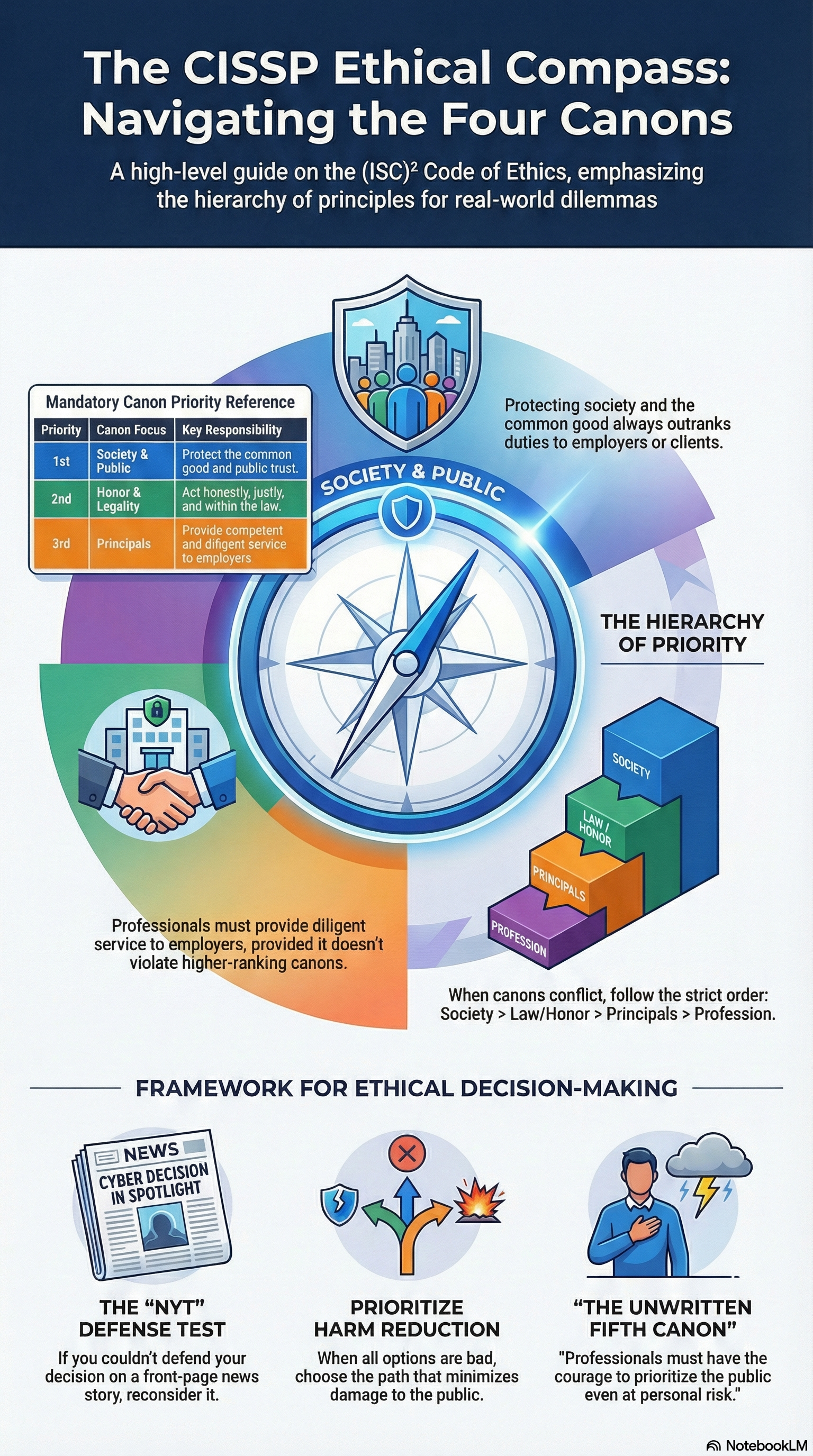
Canon 1 > Canon 2 > Canon 3 > Canon 4. When in doubt, protecting the public wins.
3. Seek legal and ethical counsel.
You're not expected to navigate complex legal/ethical conflicts solo. Talk to your organization's legal team, your professional liability insurer, or an (ISC)² ethics hotline.
4. Document everything.
If you're going to blow a whistle or refuse a directive, make sure you have a paper trail. Ethical decisions are easier to defend when you can prove you acted in good faith.
5. Ask: "Can I defend this decision publicly?"
If you wouldn't want your choice printed on the front page of the New York Times, reconsider.
6. Prioritize harm reduction.
When all options are bad, pick the one that minimizes damage to the public, even if it costs you personally.
🌿 Real-World Case Study: The Colonial Pipeline Dilemma
In May 2021, Colonial Pipelinea critical fuel infrastructure providerwas hit by ransomware. The attack disrupted fuel supply across the U.S. East Coast. Colonial paid the ransom: $4.4 million.
Put yourself in the CISO's shoes.
Canon 1: Protect infrastructure and the public. Paying ransoms funds criminal enterprises and incentivizes future attacks. Refusing might mean weeks of fuel shortages.
Canon 2: Act legally. Paying ransoms isn't illegal (in this case), but it's ethically fraught.
Canon 3: Serve your principal. Your employer needs to restore operations now. The business impact of prolonged downtime is catastrophic.
What's the right call?
Colonial chose to pay. Many criticized the decision. Many others defended it. Both sides cited the Code.
That's the thing about ethics: reasonable people can disagree. The Code doesn't provide a formula. It provides a framework. The hard partthe judgment, the courage, the willingness to accept consequencesthat's on you.
The CISSP Exam vs. The Real World
Here's a dirty secret: the CISSP exam tests memorization of the Code, not application of it.
You'll get questions like:
"Which canon takes priority when there is a conflict between protecting the public and serving your employer?"
Answer: Canon 1.
Easy. Textbook. But in the real world, "Canon 1 wins" doesn't tell you how to protect the public without destroying your career, or when the harm threshold justifies whistleblowing, or whether you can thread the needle by escalating internally first.
The exam treats ethics as static. The job treats ethics as dynamic.
This isn't a criticism of (ISC)². It's a reminder that the certification is a starting point, not an ending point. The Code gives you principles. Experience teaches you how to wield them.
Conclusion: The Canon You Didn't Swear To
There's a fifth canon, unwritten but implied:
Have the courage to lose your job over this.
Because that's what the Code ultimately demands. If you're not willing to prioritize the public over your paycheck, Canon 1 is just words.
Most CISSPs will never face that choice. Most will spend entire careers navigating minor ethical gray areas, balancing competing interests, and doing the best they can within imperfect systems.
But some will. Some will discover a cover-up, witness fraud, or be pressured to hide a breach. And in that moment, the Code stops being theoretical.
The CISSP isn't just a technical credential. It's a moral commitment. You swore an oath. That oath has teeth.
The question isn't whether you've memorized the four canons.
The question is: when it matters, will you honor them?
The (ISC)² Code of Ethics is available at [isc2.org/ethics](https://www.isc2.org/ethics). Every CISSP candidate agrees to uphold it as a condition of certification. Violations are subject to review and can result in revocation.